|

| Technologcal Innovation |  | Arts and Humanity | | Partnering Organizations | | Team Members | | Contests and Promotions | | Video Library |
Technologcal InnovationSYNERGY MOON develops space exploration technologies. Our approach is innovative, cost effective and inclusive. Our technological innovations are designed to make space travel and exploration more accessible for organizations and individuals.
Google Lunar X PRIZE Mission TechnologiesSYNERGY MOON is developing a family of space travel and exploration technologies specifically for use in the Google Lunar X PRIZE competition. Our mission plan is to launch a Neptune 1000 Rocket. This rocket will then deploy the CYGO Cruiser. The CYGO Cruiser will deploy the Lunar Lander which will deploy the Tesla Rover and Tesla Surveyors. The Lunar Lander, CYGO Cruiser and TubeSats will assist communicaton with the first moon based internet web server and addtional technology for scientific study.

Rocketry and Rocket SystemsSYNERGY MOON utilizes a new generation of low-cost, rapid-response manned and unmanned orbital launch vehicles. NEPTUNE Series rockets are designed for minimum cost and maximum reliability. Unnecessary, expensive, complex, failure-prone, and performance-limiting systems such as wings and turbopumps have been eliminated from their design. Since the NEPTUNE Series launch vehicles are designed to be deployed from the ocean, launch costs will be relatively insignificant (compared to standard spaceport fees), and launch scheduling will be based on customer demand (not on placement in a spaceport's launch rotation).
Modular Rocket SystemsEach member of the NEPTUNE Series of launch vehicles is assembled from multiple Common Propulsion Modules (CPM's). Both Small and Large CPMs are currently under development at IOS. The CPM selection is based on the launch vehicle application and projected cost. Payload capacity can be varied by increasing or decreasing the number of CPM's or the size of the CPM used in the rocket's CPM cluster. The first series of NEPTUNE launch vehicles will utilize the small CPM's.
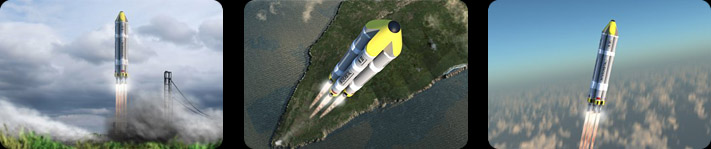
Neptune 1000, Modular Rocket SystemThe NEPTUNE 1000 is a multi-stage medium-lift launch vehicle capable of launching a 1000-Kg payload into low-earth orbit or a 190-Kg payload to Earth escape velocity. The rocket is composed of 33 Small Common Propulsion Modules.The NEPTUNE 1000 is planned to launch the Google Lunar X PRIZE Team SYNERGY MOON lander & rover to the Moon.
Team SYNERGY MOON's Lunar Lander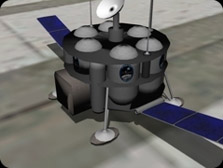
Lander TechnologyThe lander will is designed to deploy the Tesla Rover and Tesla Surveyors on to the lunar surface. It is smart machine, featuring the first moon based internet web server, a communications relay, and cameras for observing its lunar surroundings and the first lunar based telescope for making observations of cis-lunar space.
Enter the Name the Lander Contest
SYNERGY MOON is going to the moon as part of the Google Lunar X PRIZE, to pave the way for humanity's expansion to our nearest celestial neighbor. Via donations through Trans Lunar Research, our Non-profit 501(c)(3) fiscal sponsor, we're involving everyone with the chance at assisting us in fundraising for our lunar lander while giving them the chance to name it. Our lander will deliver our Tesla Rover & Surveyors, then become our first automated lunar base, performing research and contributing to the Lunar Art Capsule art projects!
Visit our Contests and Promotions page for all the latest information and updates.
Interplanetary Robitcs, Rovers and Surveyors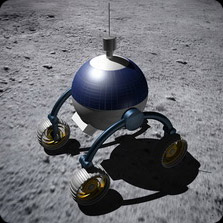
The Tesla RoverAs a part of the Google Lunar X PRIZE we have designed the Tesla Rover whos mission is to successfully travel 500 meters over the lunar surface, and send images and data back to the Earth.
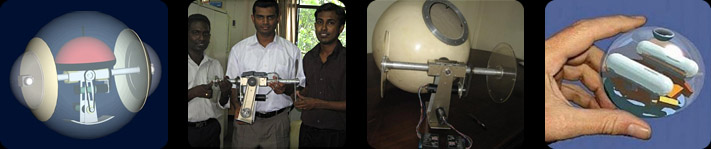
The Tesla SurveyorThe Tesla Surveyor is a spherical rover, designed as a virtual excursion vehicle. Equipped with twin high definition video cameras for stereoscopic vision, the Tesla Surveyor will take viewers on a trip across the surface of the moon. The Tesla Rover is a more traditional 4 wheeled rover, designed as a virtual prospector, with sensors and cameras to examine the environment and identify the mineral content of the rocks and lunar regolith.Both the Telsa Rover and surveyors will be capable of autonomous operations, able to take care of themselves and carry out exploration missions on their own, saving their observations for later transmission to earth or streaming near real time video of their adventures. The Tesla Rover will also carry a set of microbots, that will carry out specialized scientific and artistic projects.
Manned Orbital Space Travel
NEPTUNE TSAAHTOThe modular NEPTUNE TSAAHTO (Two-Stage-and-a-Half-to-Orbit) is designed primarily for manned orbital applications. Its launch system is assembled from eight (8) Large Common Propulsion Modules and eight (8) Small Common Propulsion Modules. The NEPTUNE TSAAHTO will have the same configuration as the Sea Star TSAAHTO.
Two-Stage-And-A-Half-To-Orbit (TSAAHTO)The NEPTUNE TSAAHTO is a pressure-fed, two-stage-and-a-half-to-orbit launcher. It has a configuration similar to the Atlas Agena. Half-staging is equivalent to dropping unused ballast. The NEPTUNE TSAAHTO is designed to place a 7,000-pound payload into a 250 mile 51º orbit. The three main components of the rocket are the Booster Module (BM), the Sustainer Module (SM), the Orbital Station Module (OSM), and the Crew Module (CM).

Orbital Station ModuleThe manned NEPTUNE TSAAHTO's dual-use (habitable when empty) pressurant tank is its most innovative design feature. Once on-orbit, an expedition crew will transfer to the rocket's specially equipped pressurant tank through a hatch in the Crew Module's heat shield. During the mission, the 14-foot (4.27-M) diameter by 20-ft (6.1-M) long tank will provide the crew with an enormous living, recreational, and work area that will feature both private and group activity zones. The expedition crew will experience spectacular Earth and space views through numerous observation ports, while enjoying weightlessness to the maximum.
Crew ModuleThe Crew Module is designed to accommodate five expedition crew members and one command pilot. The 6-person crew will be seated radially around a centrally located service compartment access hatch. Each crew member has a window providing excellent visibility. The CM is attached to the forward section of the rocket and has the following primary components: emergency escape system, life-support system, electric power system, docking collar, retro-rocket de-orbit system, attitude control system (ACS), parachute recovery system, and an aft heat-shield for reentry.
Satellite Designs and Deployment
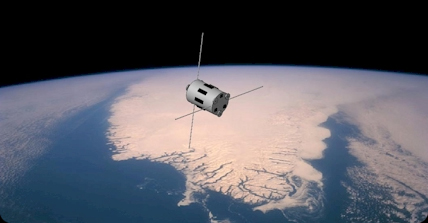
Tube SatellitesPlanet Earth has entered the age of the Personal Satellite with the introduction of Interorbital's TubeSat Personal Satellite (PS) Kit. The new IOS TubeSat PS Kit is the low-cost alternative to the CubeSat. It has three-quarters of the mass (0.75-kg or 1.65-lb) and volume of a CubeSat, but still offers plenty of room for most experiments or applications. And, best of all, the price of the TubeSat kit actually includes the price of a launch into Low-Earth-Orbit on an IOS NEPTUNE 30 launch vehicle. Since the TubeSats are placed into self-decaying orbits 310 kilometers (192 miles) above the Earth's surface, they do not contribute to the long-term build-up of orbital debris. After operating for a few months (the exact length of time on orbit is dependent on solar activity), they will safely re-enter the atmosphere and burn-up. TubeSats are designed to be orbit-friendly. Launches are expected to begin in the fourth quarter of 2010.
Telecommunications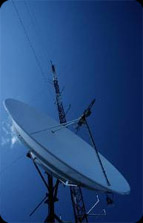
Interplanetary Communications SystemsThrough our founding partner RPC Telecommunications, SYNERGY MOON offers advanced space based telecommunications systems. As a firm of consulting engineers RPC Telecommunications specialises in all areas of satellite systems and radio transmission, but with a strong emphasis on the engineering, use, management and regulation of the radio frequency spectrum, especially for satellite networks.RPC Telecom has, since its inception in 1993, carried out consulting assignments for a range of clients including APMT, Singapore Telecom, Tongasat, ETISALAT, Thuraya Satellite Communications, DACOM, the European Commission, the European Telecommunications Standards Institute, INMARSAT, INTELSAT, EUTELSAT, the government of Vietnam, the UK Radiocommunications Agency and British Sky Broadcasting plc. |




| SYNERGY MOON FOUNDING PARTNERS
|

|
THANKS FOR OUR FIRST TEAM SYNERGY MOON GOOGLE LUNAR X PRIZE SPONSOR 
|

| Home · About Us · Press Coverage · Membership Program · Sponsorship Opportunities · Contact |